
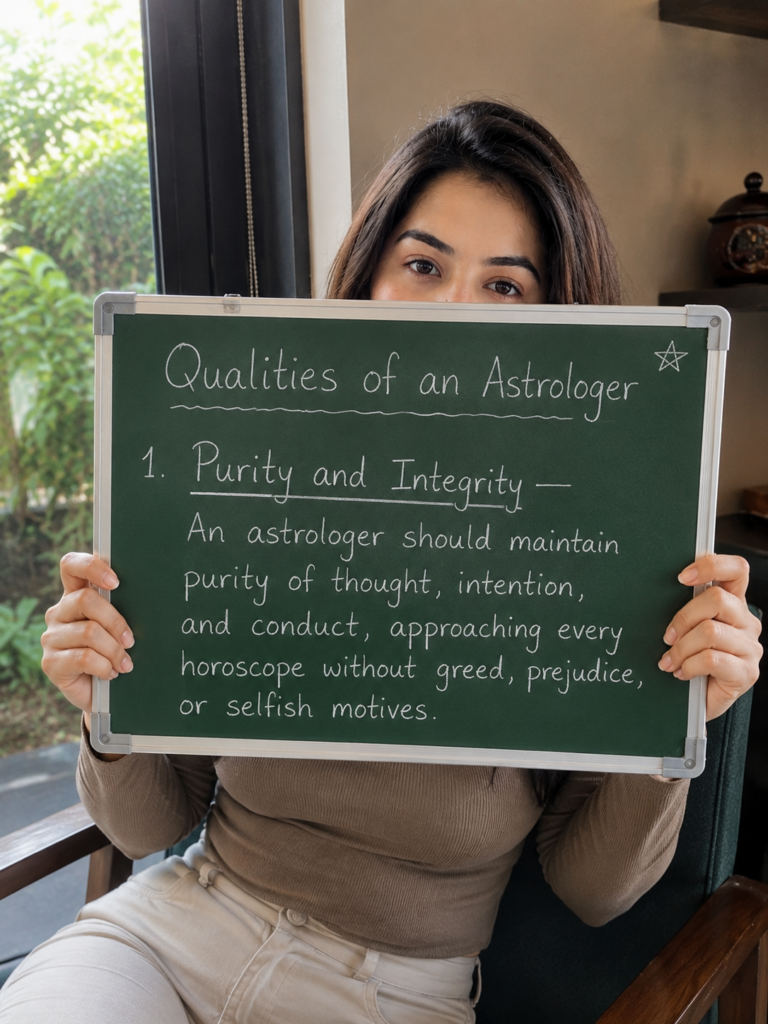
Qualities of a Good Astrologer
Astrology is not merely the ability to recognize planets, signs, houses, nakshatras and dashas. In the traditional approach to Jyotisha, the character of the astrologer is considered almost as important as his or her technical knowledge.
The material you uploaded presents this idea very strongly. One book describes astrology as a sacred discipline intended for the guidance and upliftment of people, and therefore places considerable responsibility upon the astrologer.
The photographed pages further connect the qualifications of an astrologer with teachings attributed to Maharishi Parashara and Varahamihira. When these teachings are combined with the principles found elsewhere in the uploaded books, the picture that emerges is of an astrologer who must develop three things together:
knowledge, character and wisdom.
1. Purity of Character
The first qualification is purity—both internal and external.
The photographed chapter on the qualifications of an astrologer begins the summary attributed to Varahamihira with purity. The idea is deeper than physical cleanliness. An astrologer should approach another person’s horoscope without jealousy, greed, prejudice, personal agenda or the desire to frighten the client.
The uploaded book The Origin, Meaning & Purpose of Astrology similarly says that a good astrologer should maintain internal and external purity.
A horoscope contains highly personal matters. Therefore, the mind interpreting it should be as clear as possible.
Practical meaning: before judging the chart, the astrologer should first learn to judge his own motives.
2. Truthfulness — Satya Nishtha
Truthfulness is one of the foundations of Jyotisha.
The uploaded material explicitly mentions Satya Nishtha, or commitment to truth, as a qualification of a good astrologer. Deepak Kapoor’s Astronomy and Mathematical Astrology likewise notes that classical texts expect an astrologer to be truthful as well as properly educated in the discipline.
Truthfulness, however, does not mean making dramatic statements simply because one believes them to be technically possible.
A responsible astrologer should distinguish between:
- what is clearly visible in the horoscope,
- what is only a possibility,
- what remains uncertain,
- and what cannot responsibly be concluded.
Saying “I am not certain” can sometimes demonstrate greater astrological maturity than forcing a prediction.
3. Mathematical Ability — Ganiteshu Praveena
The photographed pages reproduce the qualification Ganiteshu Praveena—competence in mathematical astrology.
Traditionally an astrologer was expected to understand the construction of the horoscope rather than merely read a chart prepared by somebody else.
This remains important even in the computer age.
B.V. Raman emphasizes that proper calculations are essential for correct prediction and that the student should understand the mathematical foundations rather than depend blindly upon results. Deepak Kapoor similarly treats mathematical astrology as the foundation upon which predictive astrology is built.
A serious astrologer should therefore understand, according to the level of practice, such matters as:
birth data, planetary positions, Lagna, houses, divisional charts, dashas and other relevant calculations.
Software should assist knowledge—not replace it.
4. Deep Knowledge of Astrological Principles
Knowing a few combinations does not make someone an astrologer.
The photographed material describes “depth of astrological knowledge” as an essential qualification. The astrologer must understand not only principles but also how they apply to an actual horoscope.
This distinction is crucial.
One may memorize hundreds of yogas and still struggle to interpret a complete chart because a horoscope contains many simultaneous and sometimes apparently contradictory indications.
The uploaded book itself warns that simply knowing stars, rashis, planets and transits is insufficient to make someone a good astrologer.
The real skill is synthesis.
5. Judicial Balance — Nyayavid
One of the most profound qualifications in the photographed pages is Nyayavid—the capacity for balanced judgment.
A horoscope rarely gives only one indication.
One combination may support an event while another weakens it. A planet may be favourable from one perspective and problematic from another. Dasha, strength, house position, aspects and divisional charts may modify the apparent result.
The astrologer therefore behaves somewhat like a judge:
collect the evidence → weigh conflicting indications → determine their relative strength → arrive at a measured conclusion.
This is why astrology cannot be practised successfully by mechanically applying isolated rules.
6. Buddhi — A Sharp and Continuously Developing Intellect
The photographed material explains Buddhiman as possessing an alert, probing and intelligent mind.
More importantly, intelligence is presented as something that should continue developing.
A serious astrologer learns from:
successful predictions, failed predictions, difficult horoscopes, teachers, classical texts, observation and experience.
A failed prediction should therefore not simply be forgotten. It should become a case study:
What was overlooked?
Was the birth time reliable?
Was one combination given too much importance?
Was a divisional chart ignored?
Was the timing technique incorrectly applied?
An astrologer who examines his mistakes becomes stronger with experience.
7. Ability to Synthesize Contradictory Indications
This deserves separate emphasis.
Charts often contain conflicting testimonies. The photographed material explains that an astrologer needs the balance necessary to synthesize contradictory planetary indications and reach sound judgment.
This is one of the great differences between a student of astrology and a practising astrologer.
A beginner asks:
“What does this planet mean?”
A mature astrologer asks:
“What does this planet mean in the context of everything else operating in this horoscope?”
No single yoga, placement or transit should automatically dominate the entire interpretation.
8. Desha–Kala Knowledge
The photographed material uses the expression Deshadikalagyo and explains the importance of understanding geography, traditions, culture and social circumstances.
This principle remains extremely relevant.
The same planetary combination cannot always manifest identically in every:
country, historical period, culture, economic condition, profession, gender role, family structure or social environment.
Astrological symbolism must therefore be interpreted within the native’s real circumstances.
Prediction without context can become technically clever but practically meaningless.
9. Control of the Senses — Jitendriya
The photographed material also identifies Jitendriya, control over one’s senses and desires.
This becomes particularly important because clients reveal private information—relationships, fears, finances, family conflicts, ambitions and weaknesses.
Such knowledge creates responsibility.
The astrologer should never exploit the vulnerability of the person seeking guidance.
The uploaded book specifically warns against monetary weakness and emphasizes moral control.
An astrologer’s knowledge should therefore produce responsibility rather than power over others.
10. Freedom from Greed
Receiving professional fees and being greedy are not the same thing.
The source material does not prohibit compensation; rather, it warns that attachment to money should not dominate the astrologer’s judgment.
Greed becomes dangerous when it encourages an astrologer to:
create unnecessary fear, prolong consultations unnecessarily, recommend remedies for personal profit, or exaggerate problems so that the client becomes dependent.
The purpose of consultation should remain guidance.
11. Confidentiality
One of the clearest ethical instructions in the uploaded book is that a person’s horoscope should not be discussed with others.
This is essentially a traditional principle of client confidentiality.
People reveal extremely private matters during astrological consultations. Their charts, problems and personal histories should not become entertainment or gossip.
If charts are used for teaching, identifying information should ideally be removed unless permission has been obtained.
Trust is part of the astrologer’s responsibility.
12. Command Over Language
The photographed pages describe both linguistic learning and what they call the “gift of gab.”
This should not be understood merely as eloquence.
Astrological knowledge is useless to the client if the astrologer cannot communicate it clearly.
The astrologer should know:
what to say, how much to say, how to say it and when to remain silent.
Technical expressions may be appropriate in a classroom, but a worried client often needs simple language.
A good astrologer converts complexity into clarity.
13. The Ability to Listen
Communication is not merely speaking.
The photographed text emphasizes language partly because the astrologer must listen to the consultant and understand him or her.
Many errors can arise when the astrologer becomes so eager to demonstrate knowledge that the consultation turns into a lecture.
Listening reveals the person’s actual question.
Sometimes the client asks about career when the deeper concern is financial security. Sometimes the stated question is marriage while the real issue is emotional uncertainty.
Careful listening improves interpretation.
14. Ability to Ask Intelligent Questions
The photographed pages specifically list the capacity to put intelligent questions.
Good questions help clarify circumstances and allow deeper interpretation.
The purpose, however, should not be to extract enough information to pretend that astrology revealed everything.
Questions should clarify—not manufacture—the prediction.
This requires intellectual honesty.
15. Oohapohapatu — Capacity for Analysis and Lateral Thinking
Another particularly valuable qualification shown in your photographed material is Oohapohapatu.
The accompanying discussion explains this as the ability to examine an issue from different angles, reconcile contradictions and think laterally.
This is extremely important in modern astrology because professions and lifestyles have multiplied enormously.
Ancient astrological principles may remain the starting framework, but their manifestation has to be intelligently understood in contemporary circumstances.
The astrologer must therefore learn principles rather than merely memorize labels.
16. Brilliance in Interpretation
The photographed chapter calls this brilliance—the capacity to examine a vast amount of astrological information and reach a sound conclusion.
A horoscope may involve:
Lagna, planets, bhavas, lordships, aspects, yogas, strengths, divisional charts, dashas, transits and other techniques.
The astrologer’s task is not to recite everything visible.
The real skill is determining:
What is important?
What is secondary?
What is actually operating now?
Good astrology reduces complexity into meaningful judgment.
17. Inner Quietude
One of the finest qualities listed in the photographed pages is inner quietitude.
An astrologer may encounter combinations that appear alarming. If the astrologer himself becomes emotionally disturbed, fear can easily be transferred to the client.
The astrologer therefore needs a calm mind.
Inner steadiness allows difficult indications to be examined without panic, exaggeration or sensationalism.
This is especially important because people often consult astrologers precisely when they are already anxious.
18. Fearless—but Responsible—Speech
The photographed material says that an astrologer should possess fearless speech arising from sound astrological insight.
Fearlessness should not be confused with harshness.
The ideal combination is:
courage + evidence + compassion + restraint.
An astrologer should not change an interpretation simply to please the client. At the same time, uncertainty should never be disguised as certainty.
19. Diplomacy and Sensitivity
Some subjects require exceptional care.
The uploaded book specifically advises diplomacy when dealing with severe hardship and sensitive relationship matters.
This principle can be extended to consultations involving emotionally charged areas such as marriage, family conflict, financial difficulty and major life transitions.
A technically correct observation delivered carelessly can still cause unnecessary harm.
The astrologer’s responsibility therefore extends beyond prediction to presentation.
20. Do Not Create Fear
This is one of the most important practical principles.
Astrology should illuminate a person’s situation rather than make the person frightened of planets.
The uploaded source describes astrology as being intended for guidance and upliftment and says that people arriving with anxiety should leave with appropriate guidance and encouragement.
Therefore statements such as:
“Everything is ruined.”
“You will definitely divorce.”
“This planet will destroy your life.”
should not become the normal language of responsible astrology.
Astrological indications should be expressed as tendencies, periods of challenge, areas requiring awareness and possibilities—not unnecessary sentences of doom.
21. Useful Forewarning
The photographed pages include “Useful Forewarning” among the qualifications.
This beautifully defines one of astrology’s practical purposes.
If a difficult period is indicated, the purpose of knowing it beforehand is not to become frightened.
It is to become better prepared.
A useful prediction should answer two questions:
What should I watch for?
and
What can I do wisely during this period?
Prediction becomes valuable when knowledge leads to intelligent action.
22. Spiritual Discipline
The photographed material states that an astrologer should be a spiritual person and lead a disciplined life.
The uploaded book similarly speaks of Satya Nishtha, worship and cultivation of a pure mind, and connects the development of astrological intuition with practices such as upasana and dhyana.
Within the worldview of these sources, astrology is therefore more than intellectual calculation.
It requires the refinement of the astrologer himself.
Knowledge develops the intellect; discipline develops the person using that knowledge.
23. Intuition Supported by Knowledge
The uploaded sources give an interesting balance between calculation and intuition.
B.V. Raman emphasizes mathematical competence, but also warns against becoming so absorbed in calculation that intuition is neglected. Another uploaded text likewise argues that astrological practice cannot be reduced merely to collecting rules and facts.
The ideal astrologer therefore develops both:
Ganita — calculation and technical accuracy
and
Prajna — mature insight and judgment.
Intuition without knowledge can become imagination.
Knowledge without judgment can become mechanical.
The astrologer needs both.
24. Capacity to Observe Signs and Omens
The photographed pages include the capacity to interpret signs and omens.
The text compares this with the way a psychologist observes how a person enters, sits, behaves and speaks.
The broader lesson is observation.
A good astrologer does not live only inside formulas. He develops sensitivity toward people, circumstances, timing and patterns.
Observation strengthens judgment.
25. Freedom from Addiction
The photographed material explicitly lists freedom from addiction.
The reasoning is straightforward: someone whose own judgment is repeatedly clouded cannot easily provide balanced guidance to others.
Self-control therefore becomes part of professional competence.
This again shows how traditional Jyotisha does not completely separate the astrologer’s personal character from his capacity to practise astrology.
26. Knowledge of Mantra and Traditional Remedial Principles
The photographed material includes knowledge of mantras for planetary propitiation and describes their purpose as helping restore calm and peace.
The broader principle is important: an astrologer recommending remedies should understand what he is recommending.
Remedies should not become a commercial afterthought attached automatically to every prediction.
Your uploaded notes also contain a strong ethical warning against turning remedies into a source of commission and emphasize remedies intended to produce constructive actions rather than exploitation.
27. Humility
Humility is essential because astrology contains enormous complexity.
The photographed discussion of purity speaks of interpretation with humility and clarity. The broader uploaded material also shows that even extensive knowledge does not guarantee that every horoscope will be interpreted perfectly.
The mature astrologer therefore does not think:
“I know everything.”
He thinks:
“This is what the chart appears to indicate according to the principles I understand.”
That difference protects both astrologer and client.
28. Continuous Study and Practice
Astrology cannot be mastered merely by completing a course.
The uploaded material emphasizes the huge number of principles, yogas and combinations involved and states that continuous practice improves one’s capacity to remember and recognize them.
A serious astrologer should therefore continue:
studying, maintaining case records, checking predictions, comparing results, revisiting mistakes and refining judgment.
Experience should deepen knowledge rather than merely increase confidence.
29. Never Become Overdependent on Software
This is especially relevant today.
The photographed text on mathematical ability observes that computers and software can themselves contain errors. B.V. Raman’s work similarly treats mathematical understanding as foundational to sound interpretation.
Software can calculate.
It cannot automatically provide wisdom.
The astrologer should know enough to recognize when the data, calculation or interpretation appears unreasonable.
30. The Client Should Leave Stronger, Not Weaker
Perhaps this is the best practical test of an astrologer.
The uploaded source says that people who approach with anxieties should leave comfortably, with guidance and encouragement.
The purpose is not necessarily to tell the client that everything will be wonderful.
Sometimes difficult truths must be discussed.
But after the consultation the person should ideally possess:
greater clarity, greater preparedness, greater understanding and a constructive direction.
An astrologer should not create psychological dependence in which the client becomes afraid to make ordinary decisions without another consultation.
The highest use of guidance is to help people become wiser in handling their own lives.
The Three Pillars of a Good Astrologer
All these qualifications can ultimately be condensed into three pillars.
1. Shastra — Knowledge
The astrologer must know the subject deeply: calculation, principles, interpretation, timing techniques and the ability to synthesize a complete horoscope.
2. Sheela — Character
Truthfulness, purity, confidentiality, self-control, freedom from greed, humility and ethical conduct protect the sacred relationship between astrologer and consultant.
3. Viveka — Wisdom
The astrologer must know how to apply knowledge: what deserves emphasis, what should be treated cautiously, what should be communicated, how it should be communicated and how the consultation can genuinely help the person.
Remove Shastra, and astrology becomes guesswork.
Remove Sheela, and knowledge can become exploitation.
Remove Viveka, and technically correct information can still become harmful.
A good astrologer needs all three.
Final Principle
The photographed pages conclude with an important idea: an ideal astrologer possessing every qualification may be rare, but students should continually strive to cultivate as many of these qualities as possible.
That may be the most practical teaching of all.
Becoming an astrologer is not merely learning how to read a horoscope. It is simultaneously learning how to refine the person who reads it.
The deeper the knowledge becomes, the greater should become the astrologer’s humility, responsibility and compassion.
Astrology then moves beyond prediction and becomes what your source describes it as being intended to be—a means of guidance and upliftment.
Sources Used
- The Origin, Meaning & Purpose of Astrology — Chennareddy Vasudev, Chapter 12, “The Nature of a Good Astrologer,” p. 123 onward.
- Graha and Bhava Balas — B. V. Raman, especially the preface discussing mathematical competence, correct calculation and intuition.
- Astronomy and Mathematical Astrology — Deepak Kapoor, material describing the classical expectation that an astrologer be truthful and versed in mathematical and traditional disciplines.
- Uploaded photographed pages, Chapter 6: “An Astrologer—Qualifications,” pp. 31–34, presenting qualifications attributed to Maharishi Parashara and a summary attributed to Varahamihira.
- Uploaded photographed pages from “Professions — A General Approach,” pp. 11–12, discussing Ganiteshu Praveena, Nyayavid, Buddhiman, Deshadikalagyo, Jitendriya, Oohapohapatu and knowledge of Hora Skandha.
